


Hello, everybody. So much to cover today. The Iran ceasefire is collapsing in real time, with the U.S. sinking Iranian boats and Iran firing missiles at the UAE. Republicans just tucked a billion dollars for Trump's White House ballroom into a reconciliation bill, alongside $38 billion for ICE. And Trump is publicly calling on states to cancel elections already in progress so Republicans can rig new maps before November.
1. Iran Strikes Back As Ceasefire Verges on Collapse
The fragile U.S.-Iran ceasefire devolved into direct military exchange Monday as Iran launched cruise missiles, drones, and small boats at U.S. Navy ships and commercial vessels in the Strait of Hormuz, and the U.S. military responded by sinking seven Iranian boats.
The exchange was triggered by the launch of “Project Freedom” — Trump’s operation to escort civilian ships out of the blockaded strait — which Iran immediately characterized as a ceasefire violation. The UAE bore the brunt of Monday’s escalation, with its defense ministry confirming it had intercepted four drones, three cruise missiles, and 12 ballistic missiles launched at UAE territory and an Emirati oil tanker near the strait.
Trump told Congress just last Friday that “hostilities” with Iran had “terminated” and that “there has been no exchange of fire between United States Forces and Iran since April 7, 2026.” That letter is now three days old.
Hegseth held a Pentagon briefing this morning insisting the “ceasefire is not over” even as both sides exchanged fire in the same waterway. Here’s General Caine making, in my opinion, this unconvincing case:
That is not a sustainable operation. Two U.S.-flagged vessels did move through the strait under escort, but former Defense Department official Seth Jones warned there simply are not enough U.S. assets to escort anything close to the 120 ships that transited the strait daily before the war.
With hostilities escalating, we will likely know whether the ceasefire formally collapses in the next 48 hours. If the rhetoric of Iran’s chief negotiator is any indication, we will see further escalation in the coming hours. He said, and I quote: “We know full well that the continuation of the status quo is intolerable for America; while we have not even begun yet.” More to come here soon.
2. Republicans Just Tucked $1 Billion for Trump’s White House Ballroom Into a New Reconciliation Bill
Senate Judiciary Chairman Chuck Grassley on Monday released reconciliation bill language that includes up to $1 billion for Secret Service “security adjustments and upgrades” tied to Trump’s planned White House ballroom project — packaged alongside $38 billion for ICE and $3.5 billion for Customs and Border Protection.
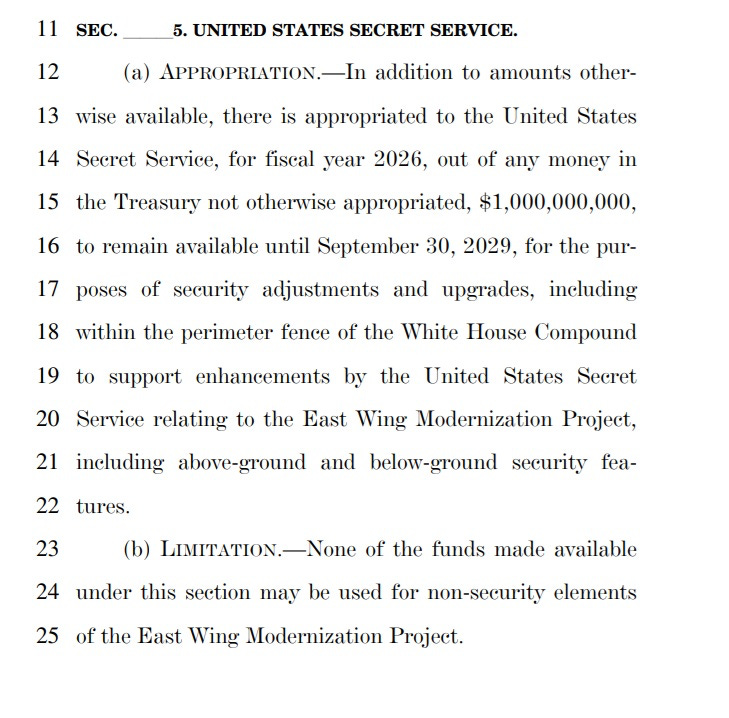
Trump originally said in July 2025 the 90,000-square-foot ballroom would be funded entirely through private donations, and the White House subsequently raised hundreds of millions from corporations including Amazon, Meta, Altria, Lockheed Martin, and NextEra Energy. Now those same Republicans who cheered the private-funding model want taxpayers to cover $1 billion more.
The Senate’s reconciliation process means this can pass with a simple majority — no Democratic votes needed. None of the funds would expire until September 30, 2029 — well into the first year of the next president’s term.
The Senate Judiciary Committee is expected to mark up the bill when lawmakers return from recess next week, with a full Senate vote targeted within two weeks. While some Republican Senators have grumbled about the bill, consider me skeptical that there will be enough Republicans peel off to remove the ballroom funding.
Let’s put this in perspective: Gas is $4.30 a gallon. 14 service members have died in a war Congress never authorized. And the country is nine weeks into a military conflict with no exit strategy. But Republicans want to spend a billion dollars on Trump’s ballroom. Because America First. Or something.
3. Trump’s Revenge Tour Hits Indiana Today — Seven Republican Senators Targeted for Crossing Him
Indiana Republicans head to the polls today in a state Senate primary that has become the first major test of President Trump’s ability to punish members of his own party who refused to follow orders on gerrymandering.
In December, the Indiana state Senate’s Republican supermajority killed Trump’s push to redraw the state’s congressional map to add two new GOP House seats. Trump took it personally and has endorsed primary challengers against seven of the eight incumbents on the ballot, with MAGA-aligned groups spending an estimated $9 million in a state where state Senate primaries normally see almost none.
The explicit goal is to defeat enough sitting senators to force Senate President Pro Tem Rodric Bray out of leadership — and Trump has personally vowed to back a primary challenger against Bray himself when his seat comes up. Here he is from the White House a few months ago:
This is bigger than Indiana. It’s a test of whether Trump’s political machine can actually purge Republicans for a single vote. If most of the seven survive, the limits of his retribution show, and other Republicans will notice. If most lose, every Republican legislator with a 2026 primary gets the message that crossing Trump ends careers.
The spread matters — a 4-3 split lands very differently than a 7-0 sweep. Turnout is running ahead of recent midterm primaries. And watch what the surviving incumbents say tomorrow morning, because their tone will tell every Republican in Washington whether voting your conscience is still survivable.
Jim Buck, an 18-year incumbent fighting for his seat tonight, told a reporter last week: “We’ve never had Washington meddle into our elections like they have this time.” He’s right. The president of the United States is personally working to end the careers of state senators in his own party because they cast one vote he didn’t like. This is what retribution looks like when it scales.
4. 50% of Mississippi’s Rural Hospitals Face Closure After Trump’s Medicaid Cuts Are About to Make Dozens More Follow
Over half of Mississippi’s rural hospitals are at risk of closure or operating at a loss, and Mississippi’s hospitals are expected to lose roughly $160 million a year as a result of Medicaid cuts in Trump’s “One Big Beautiful Bill Act.”
The state-directed payments that have been a lifeline for rural hospitals are set to be reduced beginning in 2028 under those same federal cuts. Congress is simultaneously debating a $1 billion ballroom for the White House and $38 billion for ICE. What it is not debating is the accelerating collapse of rural healthcare in the states that voted for Trump by the largest margins.
Trump has been clear about how he sees this trade-off. Speaking at the White House on April 1, he said the quiet part out loud:
Greenwood Leflore Hospital, a 120-year-old public hospital serving roughly 300,000 patients in the Mississippi Delta, has filed for bankruptcy and issued formal layoff notices warning it will close on June 15 — leaving one of the poorest, most medically underserved regions in America without a hospital.
The rural hospital crisis has become a central flashpoint in Mississippi’s U.S. Senate race between Republican incumbent Cindy Hyde-Smith and Democratic challenger Scott Colom. Colom held a press conference outside Greenwood Leflore Hospital last week, calling it a preview of what other rural hospitals across the state will face if Trump’s Medicaid cuts are not reversed. Colom has made protecting vulnerable hospitals a core campaign promise and has attacked Hyde-Smith directly over her vote for the “One Big Beautiful Bill.”
5. Trump Is Openly Calling for States to Cancel Active Elections So Republicans Can Rig New Maps Before November
President Trump posted on Truth Social that Republican-led states must immediately redraw their congressional maps following last week’s Supreme Court ruling, openly endorsing the cancellation of ongoing elections to ram through new gerrymanders — saying of voters, “If they have to vote twice, so be it.”
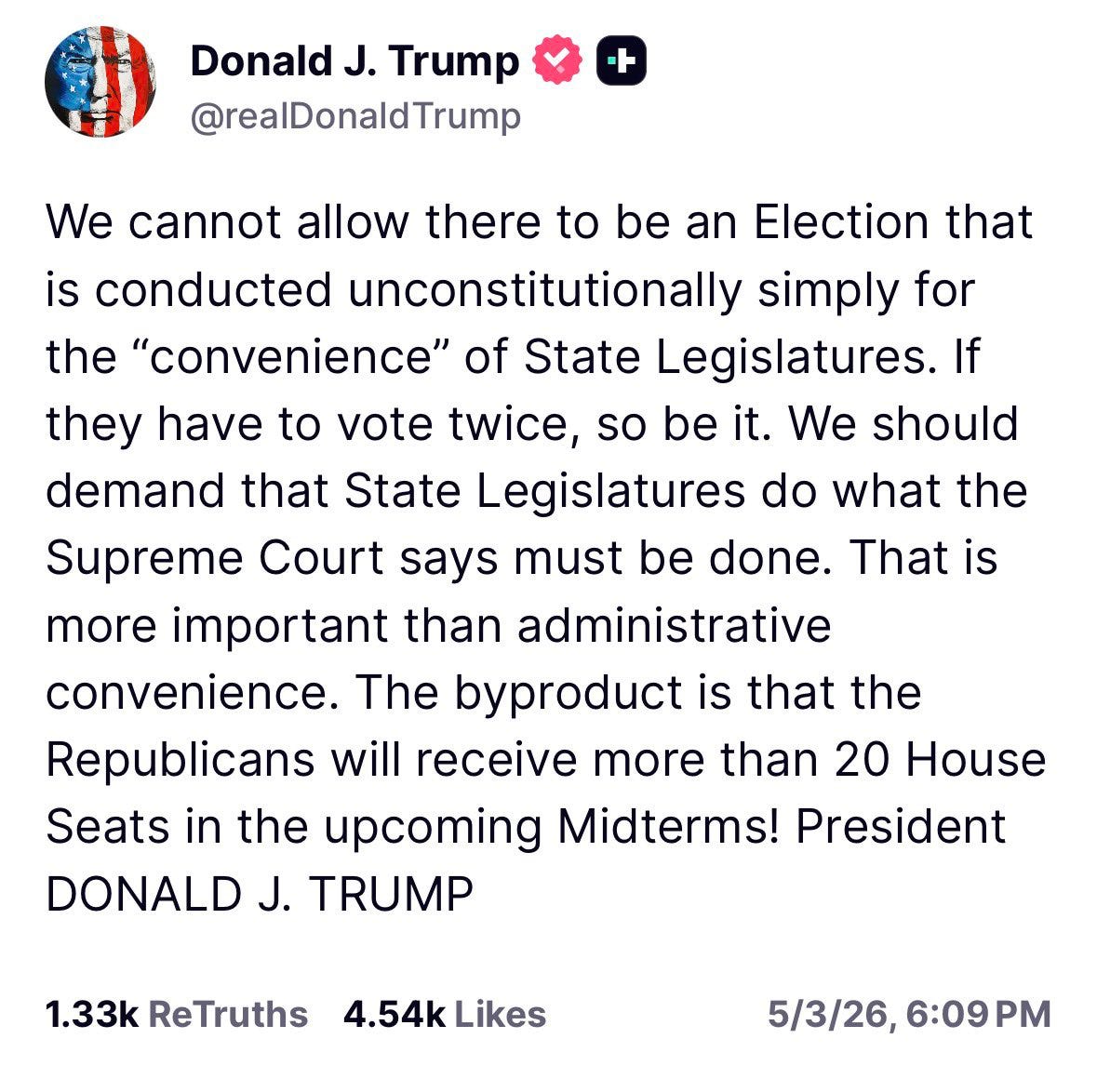
Trump claimed the redistricting push would deliver Republicans “more than 20 House seats” in the midterms, and framed holding elections under current maps as unconstitutional. Louisiana has already suspended its May 16 primary and announced it will not count votes already cast for U.S. House races. Trump personally called Tennessee Governor Bill Lee to push for a special session, and a day later Lee called one starting Tuesday. Pressure for new maps is also building in Alabama, Georgia, Mississippi, and South Carolina.
The country was already in a redistricting battle before this ruling, with Republican states redrawing maps at Trump’s direction and Democrats responding in California and Virginia. To be abundantly clear: what Trump is now proposing goes further than any redistricting fight in modern history: a sitting president publicly directing states to void elections already in progress in order to produce a more favorable map for his party six months before a midterm.
Former Republican Maricopa County Recorder Stephen Richer, who challenged his own party’s election fraud claims in 2020, put it plainly: “It will also have an impact on just how people view democracy — not deriving from the authority of the voters, but more just one big game to be manipulated.” Watch whether any Republican governors in competitive states resist the pressure, and watch the federal courts for emergency injunctions.
Some other stories that caught my eye:
Secret Service Officers Shoot Armed Man Near White House — Juvenile Bystander Wounded. U.S. Secret Service officers shot an armed man near the Washington Monument yesterday afternoon after he opened fire on agents who confronted him several blocks south of the White House complex. Secret Service Deputy Director Matt Quinn said plainclothes officers spotted “a suspicious individual that appeared to have a firearm,” followed him, and the suspect fled and fired in the direction of the officers, who returned fire. A juvenile bystander was struck and taken to the hospital with a graze wound. Quinn said investigators believe the bystander was hit by the suspect, not by Secret Service return fire. Vice President JD Vance’s motorcade had passed through the area shortly before the shooting; the motorcade was diverted out of an abundance of caution. Trump was speaking in the East Room at the time.
DOJ and USDA Open Criminal Antitrust Investigation Into the Big Four Beef Processors. Acting Attorney General Todd Blanche, Agriculture Secretary Brooke Rollins, and trade adviser Peter Navarro held a joint press conference Monday confirming an active criminal antitrust investigation into the four largest U.S. beef processors: Tyson, Cargill, JBS, and National Beef. Blanche said the DOJ has reviewed more than three million documents and interviewed hundreds of industry participants since November, urging whistleblowers to come forward through the DOJ program that pays informants 15 to 30 percent of any criminal recovery over $1 million. The Big Four control 85 percent of the U.S. beef market. Two of them — JBS USA and National Beef — are Brazilian-owned, a fact administration officials repeatedly emphasized. Concentration in beef processing has surged from 25 percent in 1977 to 85 percent in 2024, and the U.S. cattle herd is at its lowest level since the 1950s and beef prices at record highs.
Another Death in ICE Custody — the 18th of 2026, and It’s Only May. Denny Adan Gonzalez, a 33-year-old Cuban national, died April 28 in his cell at the Stewart Detention Center in Lumpkin, Georgia, the for-profit ICE facility run by CoreCivic. ICE says the suspected cause of death is suicide, with the official cause still under investigation. Staff found him unresponsive at 10:25 p.m. and pronounced him dead at 11:11 p.m. The agency notes that detainees receive medical, dental, and mental health screenings within 12 hours of arrival and that “emergency care is never denied to any detainee.” Gonzalez is the 18th person to die in ICE custody since January 1, 2026, and the 48th since Trump’s second term began. He is also the fourth Cuban detainee to die during this administration; two of those four deaths have come in the last sixteen days. The pace works out to one death every 6.5 days. Last year saw 32 detainee deaths, the highest number in two decades.


