

Note: video for paid subscribers follows article.
The Russian missile system arrived in pieces. Cargo aircraft unloaded crate after crate onto a Turkish air base in the summer of 2019. Inside were components of the S-400, one of Russia’s most sophisticated air-defense systems. For years, American officials had warned Turkey not to buy it. This wasn’t a trade dispute or a diplomatic squabble. The S-400 was designed to detect and destroy Western aircraft. Military planners feared that operating it alongside the F-35—the most advanced stealth fighter the United States has ever built—could give Russia valuable insight into the aircraft’s capabilities. That would undermine not just American security but the security of every nation flying the F-35.
Republicans and Democrats rarely agree on much anymore, but they agreed on this: Turkey couldn’t have both. The United States removed Turkey from the F-35 program, and Congress imposed sanctions under the Countering America’s Adversaries Through Sanctions Act (CAATSA). The sanctions weren’t punishment for disagreeing with Washington. They protected America’s most advanced military technology and sent a clear message: NATO members cannot deepen their military dependence on Russia without consequences.
I know that debate well because I lived it. In Congress, I served as the lead Republican sponsor of the Countering Russia’s Export of Arms Act, legislation designed to strengthen sanctions on Turkey over its acquisition of the S-400 and establish clear conditions for lifting them. I discussed the issue directly with Turkish officials, and I made the same point publicly and privately: This was never about punishing Turkey. I wanted Turkey anchored firmly in the West. But no NATO ally could deepen its military relationship with Russia while expecting access to America’s most advanced fighter aircraft. That wasn’t a political judgment. It was a national security judgment.
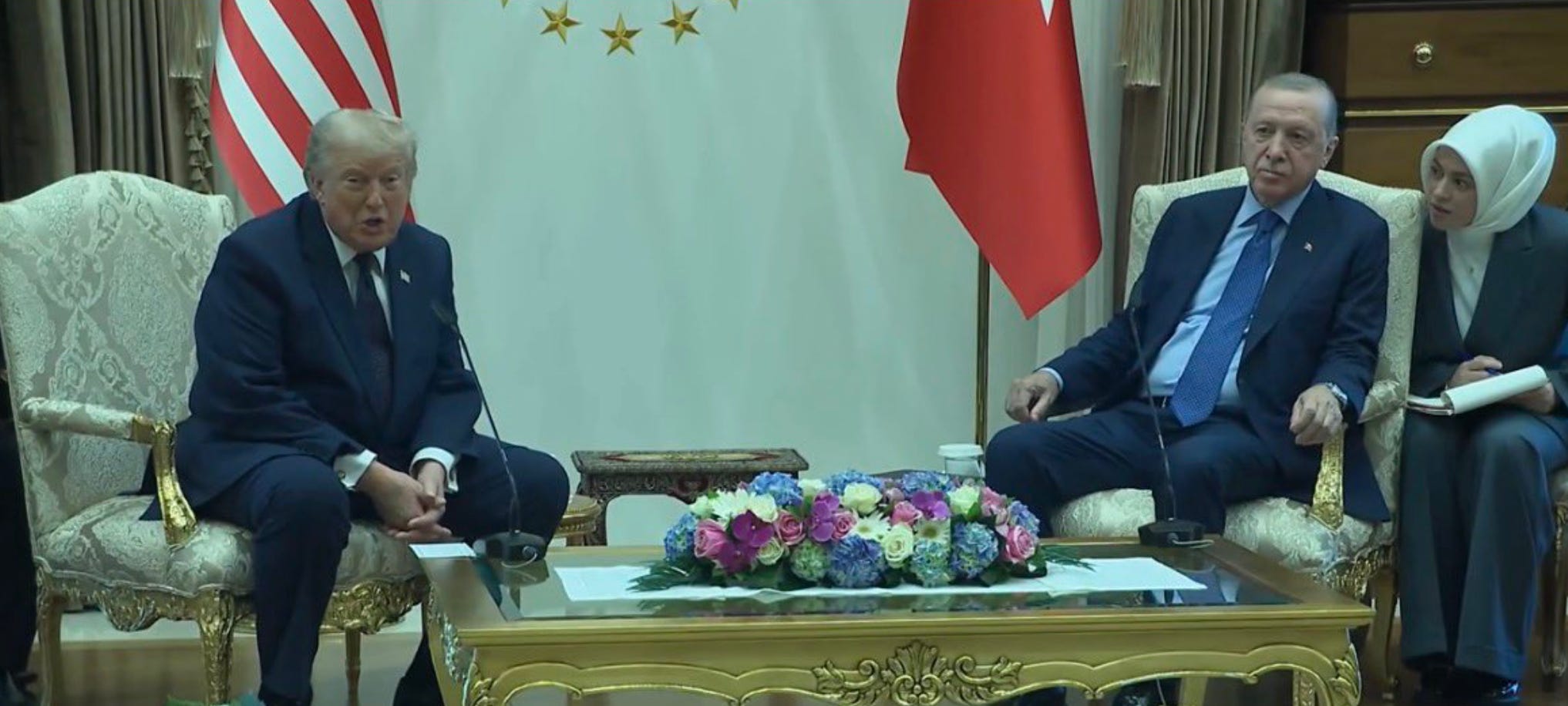
Six years later, Donald Trump appears ready to reverse that judgment. At this week’s NATO summit, Trump announced that the United States would lift the sanctions imposed on Turkey. “We’re going to be taking the sanctions off,” he said. “It’s time. We don’t want to sanction friends.” He also suggested that Turkey could once again gain access to the F-35 program, saying President Recep Tayyip Erdoğan had been “much more loyal” than other countries.
That announcement deserves more attention than it has received—not because it vindicates a position I took in Congress, but because it reveals how Donald Trump sees the world.
For nearly eighty years, American presidents of both parties shared a basic assumption about foreign policy. Democracies were imperfect. Allies could be frustrating. They often argued with us, refused our requests, and demanded compromises. But democratic allies generally strengthened America’s security, while authoritarian adversaries required skepticism and deterrence. That understanding shaped the postwar order that produced NATO, strengthened alliances across Europe and Asia, and helped prevent another global conflict between great powers.
Trump sees the world differently. Democratic allies are expected to prove themselves over and over again, while authoritarian leaders often receive the benefit of the doubt. He threatens tariffs against Europe while speaking warmly about Erdoğan. He questions support for Ukraine while restoring military cooperation with Turkey. Once you recognize the pattern, it appears almost everywhere.
This isn’t simply a collection of disconnected decisions. It’s a coherent worldview.
To understand why that matters, it helps to remember why NATO exists in the first place. The alliance was never an act of charity. After two world wars began in Europe within a single generation, American leaders reached a sobering conclusion: the Atlantic Ocean no longer guaranteed our safety. Waiting for aggression to spread before acting had twice drawn the United States into catastrophic wars at enormous human and financial cost.
Harry Truman, George Marshall, Dean Acheson, and Dwight Eisenhower concluded that America could no longer retreat behind two oceans. Strong alliances, forward-deployed forces, and collective defense would deter aggression before another world war became necessary.
NATO was not philanthropy. It was insurance.
That system has served the United States extraordinarily well. No great-power war has erupted in Europe since NATO’s founding. American influence expanded. Democratic governments flourished. Even after the Cold War ended, the alliance continued adapting to new threats, from terrorism to Russian revanchism.
Like every alliance, NATO has required constant maintenance. Presidents from Eisenhower to Obama pressed European allies to spend more on defense. None questioned the value of the alliance itself. Trump often does.
At the NATO summit, Trump again complained about America’s democratic allies. He lamented that Italy, Germany, and France had turned down American requests. Speaking about Greenland, he criticized Denmark for refusing to entertain his proposal that the United States take control of the island. Then he made a remark that should have alarmed every NATO ally: “We could remove all of our soldiers out of Europe.” America’s forward military presence on the continent is not a favor we perform for Europeans. It is one of the central pillars of the postwar security architecture that has helped prevent another great-power war. Yet Trump spoke of it as though it were just another bargaining chip in a real estate negotiation.
Alliances depend on trust. Nations make military investments, share intelligence, coordinate operations, and accept political risks because they believe America’s commitments will outlast any single election or administration. When those commitments begin to appear conditional on personal relationships or political grievances, uncertainty spreads through the alliance itself.
History offers plenty of warnings about what happens when deterrence becomes uncertain. In his book The Jungle Grows Back, Robert Kagan argues that the liberal international order is not the natural condition of the world. Stability survives only because democratic nations continuously maintain it. Left unattended, rivalry, coercion, and spheres of influence return with surprising speed.
That observation feels increasingly relevant today because Trump often describes foreign policy as though relationships between leaders matter more than relationships between nations. Loyalty, in his telling, is measured less by adherence to shared democratic principles than by personal rapport. That helps explain why Erdoğan receives such generous treatment.
Turkey remains an important NATO ally. It occupies one of the most strategically significant locations in the world, controlling access between Europe, the Middle East, and the Black Sea. Maintaining a productive relationship with Ankara is unquestionably in America’s interest.
Productive relationships are not the same as unconditional concessions. The real question is whether the security concerns that led Congress to remove Turkey from the F-35 program have actually disappeared. They haven’t.
Nothing substantial has changed about the S-400. What has changed is the occupant of the Oval Office.
The contrast with Ukraine is impossible to ignore. Ukraine is fighting to stop Vladimir Putin from redrawing Europe’s borders by force. Yet this administration has repeatedly slowed or reduced military assistance while Vice President J.D. Vance has described ending aid to Ukraine as one of the administration’s “proudest” accomplishments.
That inversion should trouble every American. One country purchased Russia’s premier air-defense system. Another is trying to survive Russian missiles. The first is rewarded. The second is asked to make do with less.
There is a phrase that keeps coming back to me: Trump wants to arm the bad guys and starve the good guys.
That may sound overly simplistic until you step back and look at the broader pattern. Democratic allies are treated as competitors. Countries resisting Russian aggression are told to lower their expectations. Authoritarian leaders receive praise, patience, and second chances. America’s closest partners face tariffs, public insults, and constant questions about whether the United States still considers alliances worthwhile.
One principle has anchored American leadership since 1945: free nations are stronger together than they are alone. Trump increasingly seems determined to test the opposite proposition.
History is not kind to countries that abandon their friends in favor of transactional relationships with strongmen. Democracies are frustrating because they argue. Legislatures interfere. Elections change governments. Compromise is slow.
Autocrats are easier. Until they aren’t.
America’s greatest strategic advantage has never been that we possess the world’s largest economy or the world’s most powerful military. Other nations have had formidable armies. Great empires have come and gone.
What has made the United States different is that, for generations, free nations wanted to stand with us. That was never an accident. It was the greatest strategic investment America ever made, and it is far easier to lose than to rebuild.
In 2019, those Russian missile systems arrived on a Turkish airfield in wooden crates. This week, Donald Trump suggested they no longer matter.
They do.
Because the real question was never about the missiles. It was about which side America chooses.
Video for paid subscribers:
