


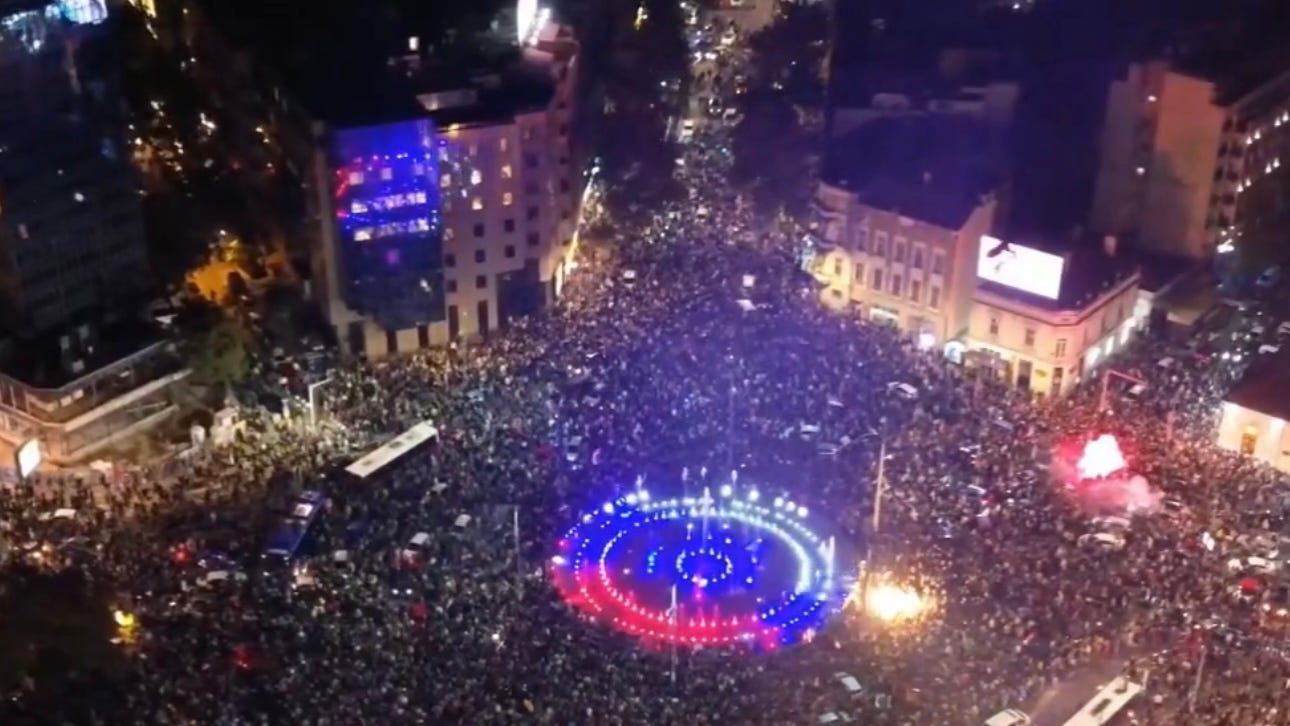
On Sunday night, the streets of Belgrade, Serbia exploded in celebration.
The moment Aleksandar Vučić admitted defeat, the city came alive. Drivers leaned on their horns. Young people poured into the streets waving flags, hugging strangers, shouting “victory” and “he’s done” until their voices gave out.
I’ve watched so many videos from Belgrade because it’s been a while since I saw that kind of joy in a crowd. It’s the joy of people who were told for years that nothing would ever change, and who just proved everyone wrong.
If you’re an American wondering what any of this has to do with you, the answer should rhyme with our politics. A strongman who leaned on the media, rewarded his cronies, and blamed a “deep state” for his troubles just lost power at the ballot box, because ordinary people refused to stop showing up. In just over a week, we get our own chance to prove the same thing can happen here.
What Happened
Here’s the short version, because you don’t need a degree in Balkan politics to understand why this matters.
Vučić has dominated Serbia for more than a decade, first as prime minister and then as president. His party has run the country for fourteen years. Over that time, critics at home and abroad accused him of doing what strongmen do: tightening his grip on the media, rewarding his allies, and making sure anyone who might challenge him never got very far.
Then, in November of 2024, the concrete canopy of a newly renovated train station in the city of Novi Sad collapsed and killed sixteen people. To a lot of Serbians, it was the perfect symbol of a government that cared more about contracts and cronies than about the people it served. University students started protesting and simply didn’t stop. For almost two years, they blockaded campuses, marched across the country, and organized what became the largest protest in Serbian history.
This fall, Vučić called a snap election, apparently confident he could ride it out. Instead, the student-backed movement is projected to win an outright majority in parliament. Turnout was close to 70 percent, the highest the country has seen in decades. Fourteen years of one-party rule ended in a single night.
And here’s something American readers will recognize immediately: in conceding, Vučić blamed Serbia’s independent media, unnamed European countries, and, I’m not making this up, the “American deep state.” Funny how strongmen have a way of reaching for the same excuses.
Going Around State Controlled Media
One part of this story deserves more attention than it’s getting. For years, the students were up against a media landscape that critics described as captured by the government. Pro-government outlets dominated the airwaves. At one point, students blockaded the headquarters of the state broadcaster, accusing it of slanting its coverage against them. One pro-government tabloid published the passport details of two student protesters and branded them foreign spies.
So the students went around it. They knocked on doors. They went village by village and made phone calls, one conversation at a time. They leaned on the independent outlets still willing to tell the truth. It’s no accident that when Vučić went looking for someone to blame on election night, independent media was at the top of his list.

Americans should recognize the contours of that story. We’ve watched major networks settle lawsuits with the President, a broadcaster threatened with the loss of its licenses over a late-night joke, and nearly the entire Pentagon press corps walk out of the building rather than accept new restrictions on what they could report. Our media isn’t captured the way Serbia’s was. But it’s under real pressure, and too many of the big outlets have flinched.
That’s a big part of why I do this work, and why this community matters so much to me. Independent media, the kind that answers to its readers instead of owners, advertisers, or anyone in power, is one of the ways a free people gets the truth when the big megaphones won’t deliver it. And every time you share something you read here with someone who isn’t getting the full story, you’re doing a small version of what those students did door to door.
What America Can Learn
To state the obvious, Serbia isn’t the United States, and I’m not predicting that November will go the same way. But there are lessons in what those students did, and they can apply in Boise just as well as they did in Belgrade.
First, they didn’t quit. For nearly two years, the students kept showing up when it seemed like nothing was changing, when the people in power ignored them, when they were tired and cold and probably wondering whether any of it mattered. Change rarely comes from one big moment. It comes from people who refuse to stop showing up.
Second, they made it bigger than a party. The students who started the movement didn’t even put their own names on the ballot. They built a broad, nonpartisan coalition around a simple promise: rebuild the economy and restore democracy. People who disagreed about plenty found something they could agree on. That’s exactly the kind of uncomfortably big coalition this moment calls for here at home.
Third, they made the result undeniable. When nearly 70 percent of a country shows up and the margin is that wide, even a strongman has no choice but to concede. That’s the most important lesson of all for us. Winning isn’t enough. The goal is to win by so much that nobody can pretend otherwise. “Too big to rig,” as some have put it in America.
And fourth, they reminded us that strongmen aren’t permanent. Vučić looked untouchable for more than a decade. Until, one Sunday night, he wasn’t.
Our Turn
The young people of Serbia didn’t have more power than we do. They didn’t have a better system to work with. What they had was persistence, a true pro-democracy coalition that was bigger than any one party, and the determination to show up in numbers too big to ignore.
We have all that available to us, too. In a little over a week, Americans get our own chance to be heard. Make a plan. Vote early if you can. Bring someone with you. Make the result so clear that no excuse about a “deep state” can explain it away.
They’re celebrating in the streets of Belgrade this week. I’d love nothing more than to see that same joy in ours come November 3rd.
— Adam
Thank you as always. I listened to Obama’s speech in Detroit and Ohio. What a wonderful speaker.?I now have hope. Why do Republicans hate Obama so much. He is not in the Epstein files?
First Hungary, now Serbia. Let's make it a perfect four -- the United States and Israel. Time for a breath of fresh air to clear fascist miasma away!