


Happy Sunday, everyone. Are you ready for some good news?
For the longest time, it has been hard not to be cynical about politics. I spent twelve years in Congress, largely during the Trump years, so I saw how that cynicism got earned. This week, though, I want to tell you about something that cuts straight through the doubts about our politics as usual.
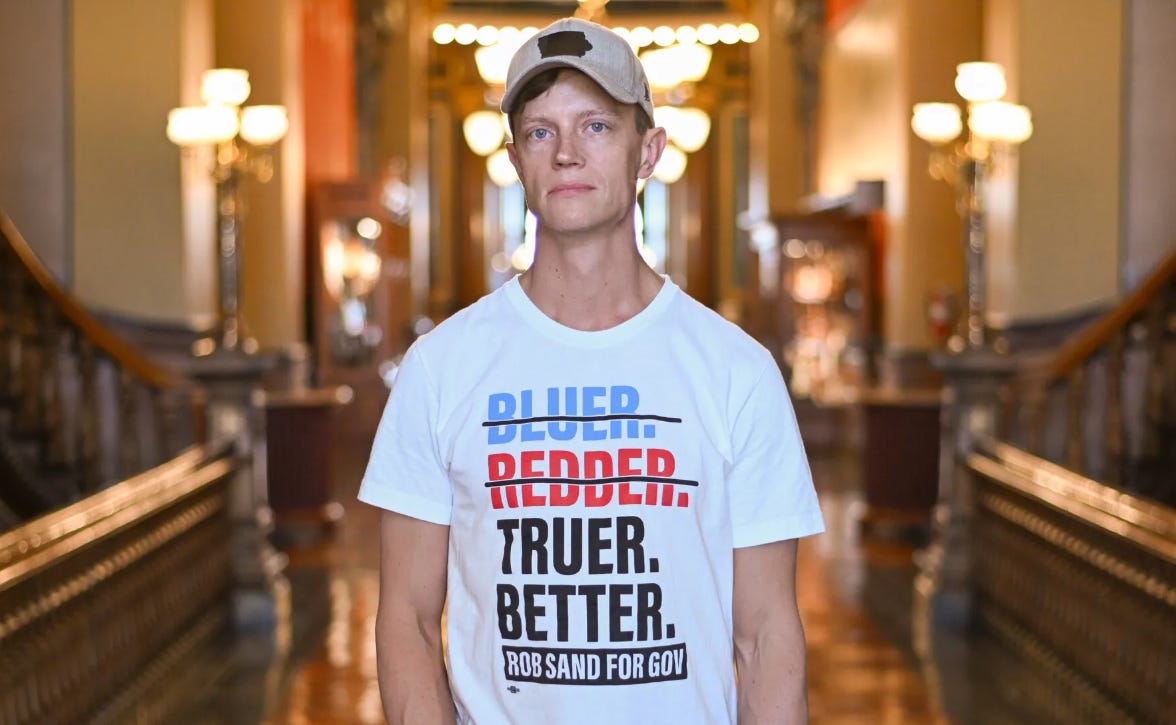
Rob Sand is the Democratic governor-elect of Iowa, and on the campaign trail he became known for a ritual. Before he took a single question at a town hall, he asked the Republicans in the room to raise their hands and for the crowd to applaud them. Then the independents had their turn and the crowd did the same. Then the Democrats identified themselves to round out the cross-partisan welcome as part of what Sand described as gratitude for showing up for our democracy. Finally, he led everyone in the first verse of “America the Beautiful.”
He did this in all 99 counties. Think about what that does for building community. Everyone in the room applauds every group, so in a county where no Democrat holds elected office, the Republicans clap for the Democrats, and in a county with barely any elected Republican leadership, the Democrats clap for the Republicans. I have stood in rooms where the other side of the aisle got treated like a threat, but in the rooms Rob Sand brought together, the other side got treated as thy neighbor.
Sand told CBS he wants people to see the other side as the other half of the same creature: “right wing, left wing, same bird.”
After the election, Sand sat down with Ezra Klein and explained what he was doing. He said every town hall included a request that people love their neighbor. Some people cried, he told Klein, because it was the first time anyone has invited them to acknowledge that we are different and then unite.
When it came time for his “America the Beautiful” routine at each campaign stop, Sand didn’t start the song himself. He handed the responsibility to someone in the audience, and he admitted he sometimes had to stop singing because he got emotional. And when it came time for questions, he gave the first microphone to a Republican to break the expectation that competing sides don’t talk to one another.
Then there is an exchange you have to see. In it, Sand says he is passing the mic to the biggest thorn in his side on social media because he wanted to hear what he has to say. Instead of shouting in our own echo chambers, Sand invited his detractor, Gary, into a dialogue.
A Change of Heart

Sand’s campaign of positive politics was beautifully more common than normal this cycle.
In Texas, James Talarico beat Ken Paxton to become the first Democrat to win a Senate race there since 1988, after a campaign built around what he called a “politics of love.” Talarico often talked about his grandfather, a Baptist preacher, who taught him that their faith comes down to two principles: love God and love your neighbor. The newly-minted Senator from the Lone Star State in fact had run a “Love Thy Neighbor” food drive across Texas during the campaign, and in Waco alone volunteers collected 1,000 pounds of food.
And just north of Talarico in Kansas, Adam Hamilton, a longtime Methodist pastor from the Kansas City area, became the first Democrat that state has sent to the Senate in 94 years. He ran on a similarly neighbor-focused foundation, and rode its momentum all the way to Washington. On NPR, in one of his first interviews since being elected, Senator-elect Hamilton said of his new Kansan colleague Sen. Jerry Moran, “I want to be his best friend in Washington.”
Three people, three states, three styles, one message: a commitment to bringing about a brighter and more caring politics after the decade plus we’ve just endured. That gives me an immense amount of hope, and what strikes me most is how little it cost to bring about a new standard of behavior. A round of applause costs nothing. A verse of a song is also free. A microphone handed across the room costs nothing either, and each of these small tweaks changes how a room feels about the people inside it.
The Bully Pulpit
For years, anger has been used as a political currency, and for a long time the people who have spent it the fastest have been rewarded on Election Day. Fear is cheap to produce and it travels quickly, so the candidate who could make someone afraid of their neighbor would more easily get a voter to show up and a donor to give. Republicans were open about that plan this year, with a Republican tied to Trump’s political operation telling Axios in July, “It’s going to be a hate election,” and described the goal as getting voters to hate Democrats more than they hate Republicans.
President Trump took that plan on the road. At campaign stops he called Democrats “radical left lunatics,” and he kept up his claim that they cheat in every election, including the one in 2020 which he lost to Joe Biden. The Republican convention in Dallas cast Democrats as communists, anti-American, and even evil. In Texas, Ken Paxton called James Talarico “the most extreme radical the Democrats have ever nominated,” and his campaign ran an AI-generated ad that stitched Talarico’s separate religious remarks into a fictional Bible reading.
Then the votes were counted and Democrats took both chambers of Congress by flipping nine Senate seats and taking more than 40 House seats away from Republicans. The GOP has their own explanations for the rout, with gas prices and the war in Iran sitting near the top of their excuses, but I would add one more.
Sand, Talarico, and Hamilton proclaimed their ideals with a song, a commandment, and an open microphone. So in a political arena built on resentment, the candidates who offered kindness stood out. For years we’ve been told that the only way to win is to make people angry and afraid of each other, but three Democrats in deep-red America just showed us how to find victory by coming together instead.
After a decade of dark and destructive politics, a better version of America is striking back through love for our neighbors and love of our country. And this week, a lot of us will get to practice that embrace when we sit down at a Thanksgiving table with someone who voted differently from us.
In doing so, be reminded of Rob Sand’s most heartfelt appeal: “we’re going to make our Thanksgiving dinners fun again!” Then say grace, or perhaps a rendition of America the Beautiful if you’re not the praying type, and take notice of the friends and family that really matter in these moments.
And that, my friends, is good news for your Sunday.
— Adam
Great article!
I wish for Schumer and Jeffries to read your column and see the people who really brought the blue tsunami over the line. Not them, not their rich friends in Washington, but the real down-to-earth people who ran for office and the real down-to-earth people who came to listen to them. If nobody had showed up in their audiences, the message wouldn’t have been delivered, but it was and it worked!