


Additional video for paid subscribers follows article
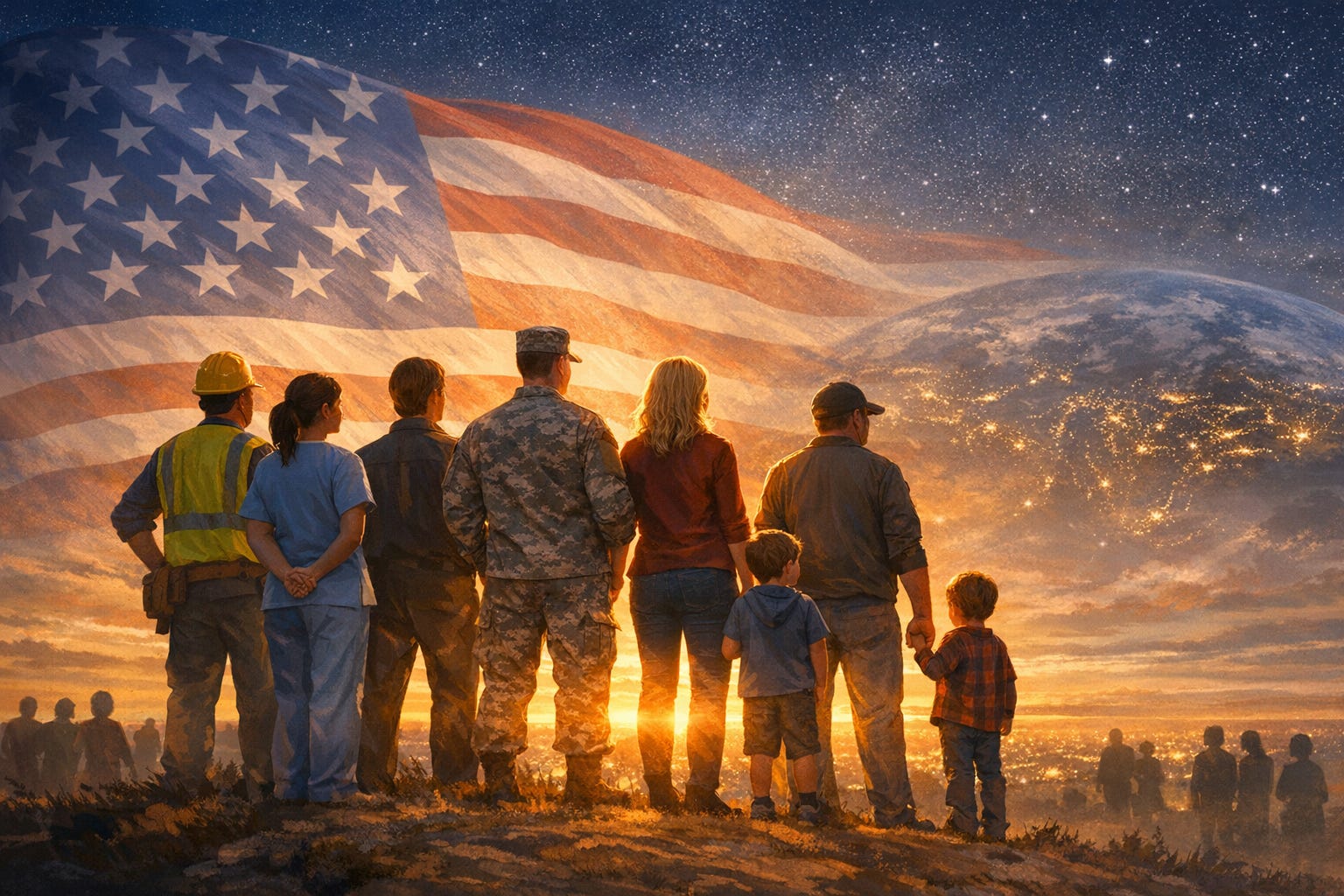
Every country tells a story about itself. For some nations, that story is about bloodlines, ancient kingdoms, or shared ethnicity that stretches back centuries. America is different. Our story has never really been about any of that. America was built around an idea — and that idea is one of the most radical concepts in human history: that ordinary people can govern themselves.
From the beginning, Americans have carried a quiet sense that our country has a mission. Most of us probably couldn’t sit down and write it out in a neat sentence. We argue too much for that. We fight about policy, about leaders, about the direction of the country. But underneath all of that disagreement there has always been something deeply ingrained in us — a belief that America is supposed to mean something beyond its borders. That we are supposed to demonstrate what self-government looks like.
Not impose it on the world. Not conquer the world. But show, through our example, that freedom actually works. I believe that our mission statement is simple in words, difficult in practice: “To be an example of self-governance to the millions, or billions, of people desperate for a taste of what we have. Freedom”
For generations, people living under dictatorships, corrupt systems, and authoritarian governments have looked toward the United States as proof that something different is possible. Our words matter, but our example matters far more. When people see a country where leaders can be voted out of power, where citizens argue openly about the future, where institutions outlast individual politicians, it plants a “dangerous” idea in the minds of people living under oppression: maybe we could do that too.
Now, none of that means America has been perfect. Far from it. Our history includes slavery, segregation, discrimination, and injustice that directly contradicted the actual ideals we claimed to represent. There were times when we treated people among us as less than equal in ways that stain our history., and of course we still are challenged by that.
There is something important about the American story that quite often gets overlooked. Again and again, we have confronted those failures and pushed ourselves closer to our aspirational ideals. The Civil War forced the country to confront slavery. The Civil Rights Movement forced us to confront segregation and systemic discrimination. Expanding voting rights forced the nation to recognize that democracy only works when everyone has a voice.
Those moments weren’t easy. They were messy and painful and deeply divisive. But every time we moved closer to the ideals written into the Declaration of Independence, the world noticed.
The images of Americans marching for civil rights in the 1960s didn’t just change our country. Those images traveled across the world. People living under apartheid in South Africa saw them. People living under military dictatorships in Latin America saw them. People living under authoritarian regimes saw them. They saw citizens demanding that their country live up to its own promise. That example mattered.
Sometimes America’s influence hasn’t come from speeches or military power. Sometimes it has come from something quieter — culture, openness, the simple visibility of freedom.
The Cold War is one of the clearest examples of that.
At the end of World War II, the United States had every reason to walk away from the rest of the world. Hundreds of thousands of Americans had died. Europe was devastated. Asia was shattered. Our country was exhausted and war-weary. Historically, when great powers win a war like that, they go home.
We could have done that. No one would have blamed us.
Instead, we stayed.
We rebuilt Europe through the Marshall Plan. We helped rebuild Japan. We built alliances designed not to conquer territory but to prevent another catastrophic war. American troops stood watch in places most Americans couldn’t find on a map because the stability of those regions mattered for the future of the world.
And while tanks and missiles mattered during the Cold War, ideas mattered even more.
Behind the Iron Curtain, people slowly began to glimpse another kind of society. Western music made its way through radio signals. American movies circulated quietly underground. Books and magazines were passed from hand to hand. Even small glimpses of freedom — open debate, creativity, individual choice — planted powerful ideas in the minds of people living under Soviet control.
By the third generation living under that system, many had seen enough to know that something better existed beyond their borders.
When the Berlin Wall finally came down, it didn’t happen simply because of weapons or diplomacy. It happened because millions of people had come to believe that freedom was possible. And a big part of what helped inspire that belief was the American example.
Today there are things the United States does quietly that shape the world in ways most Americans never think about, and may not even know. One example: the United States Navy protects global shipping lanes. That might sound like a small and insignificant policy issue, but it has enormous consequences. Because those shipping lanes allow goods like food and energy to move freely around the world.
Yes, that system benefits the American economy. Free trade benefits us. But it also benefits the rest of the world. Smaller nations can trade without fear that a stronger country will simply shut down their access to markets. Stability in the global economy allows billions of people to participate in a system that raises living standards across continents.
All of that reflects a deeper mission. America has stood as a demonstration that free people can govern themselves. It shows that power can flow from the people upward rather than from rulers downward. It shows that disagreements can be resolved through ballots rather than violence.
Lately, though, it feels like we’re forgetting that mission.
Too often our focus has shrunk inward. Our politics has become obsessed with money, economic numbers, and short-term political victories. We fight each other constantly, and its understandable. The digital age hasn’t helped. Through social media the rest of the world can begin to feel less real. Other countries become memes, viral videos, or political talking points instead of places filled with real people who have hopes, fears, families, and dreams just like we do.
But those people are still watching.
Across the world there are millions — maybe billions — of people who look toward the United States to see whether the experiment in self-government still works. They are watching to see if elections still matter. They are watching to see if citizens can still hold leaders accountable. They are watching to see if a divided country can still find its way forward.
America has faced moments like this before. There have been times in our history when division felt overwhelming and when people doubted whether the country could hold together.
The Civil War nearly destroyed us. The Great Depression shook the foundations of our democracy. The civil rights era forced the country to confront injustices that had existed for generations.
Each of those moments was a test. Each time, eventually, Americans chose to move closer to the ideals we started with. Each time the country emerged stronger.
Now, after nearly 250 years of American history, another moment rests squarely on our shoulders.
We are not being asked to sit in trenches defending our country from invasion. We are not being asked to sign a declaration of independence against a global empire.
Our challenge is quieter, but still profound.
We are being asked to keep believing in the idea.
To keep hope alive when cynicism feels easier. To defend the principle that free people can govern themselves.
When Americans remember that mission, something powerful happens. Differences that once seemed enormous begin to shrink. The language someone speaks at home, the country their grandparents came from, or the specific policy positions they hold start to matter less than the shared commitment to the system itself.
The small differences between us do not define America.
What matters is whether we are willing to stand together in defense of self-government. That commitment is the alliance that makes this country work.
If we remember that, someday people will look back at this moment the way we now look back at other turning points in our history. They will write about it. They will sing songs about it. They will tell stories about how Americans, once again, chose to defend the idea of freedom when it mattered most.
When that happens, we will be proud of the fight.
My hope — my prayer — is that my son Christian grows up in an America that is even better than our best days. A country that remembers its mission. A country that continues to inspire people around the world who are desperate for proof that freedom works.
That future isn’t guaranteed.
It depends on us.
And the truth is, Americans have faced moments like this before. When it mattered most, we found our way back to the idea that started it all.
I believe we will again.
Addl video for paid subscribers:
