

Discussion video for paid members follows story.
This morning, the President of the United States posted the following words to Truth Social: “A whole civilization will die tonight, never to be brought back again.” CBS News
Read that again. Slowly. The President of the United States — the commander-in-chief of the most powerful military in human history — announced, publicly, before a single negotiation had concluded, that a civilization was going to die. Not a government. Not a military. A civilization. Eighty-nine million people. A culture that predates the Roman Empire by a thousand years.
He has threatened to destroy all of Iran’s power plants and bridges if Tehran does not meet his 8 p.m. deadline to reopen the Strait of Hormuz. And when the White House was asked what “whole civilization” means — whether it signified targeting civilian areas — spokesman Anna Kelly said simply, “refer to the TRUTH.”
There’s your answer. They’re not even hiding it.
This Is a War Crime. Full Stop.
Let’s be precise, because precision matters when we’re talking about international law and the killing of civilians.
There are circumstances under the laws of armed conflict where striking infrastructure is legally permissible. A power plant that directly feeds an integrated air defense network — destroying it to suppress enemy fire before a military operation — has a defensible military nexus. A bridge being used exclusively to move troops and armor toward a front line can be a legitimate military target under the doctrine of proportionality and distinction. Military planners make these calculations every day, and the laws of war account for them.
That is not what this is.
Human rights expert Kenneth Roth, former executive director of Human Rights Watch, told NBC News that Trump is “openly threatening collective punishment, targeting not the Iranian military but the Iranian people.” And he was unequivocal about what that means: “Attacking civilians is a war crime. So is making threats with the aim of terrorizing the civilian population” — and that threatening to carry out a war crime is potentially a war crime itself under international humanitarian law.
France’s Foreign Minister Jean-Noël Barrot joined a growing international chorus, saying attacks targeting civilian and energy infrastructure “are barred by the rules of war, international law.”
The whole world is saying it. Legal scholars are saying it. Human rights organizations are saying it. The United Nations is saying it. And Trump’s response? He told reporters he’s “not at all” concerned about committing war crimes.
The intent here is not military victory. The intent is punishment. Retribution. Terror. The intent is to make 89 million people suffer until their government capitulates. That has a name. It’s called collective punishment, and it has been a war crime since the Fourth Geneva Convention was signed in 1949.
I Know What “Warmonger” Sounds Like. They Called Me One.
I need to say something personal here, because the hypocrisy of this moment is so breathtaking it cannot go unremarked.
When I served in Congress as a Republican, I supported Barack Obama’s proposal to strike Syria after Bashar al-Assad used chemical weapons against his own people — sarin gas deployed against civilians, including children, in their homes. It was one of the hardest positions I ever took, because it meant crossing my own party, my own base, and a president many of my colleagues viscerally opposed. I believed then, as I believe now, that there are lines in warfare that cannot be crossed, and that the United States has a responsibility to enforce them even when it’s hard.
My Republican colleagues — some of the very same people who are sitting in Congress right now, silent — called me a warmonger. They held press conferences. They went on television. They argued that striking Syria, a targeted, limited military response to a verified chemical weapons attack with a clear international legal basis, was reckless, immoral, and un-American. Obama ultimately backed down. And they cheered.
Now those same people — or their ideological successors who absorbed everything they believed — are saying nothing. Some are actively cheering. As the President of the United States threatens to extinguish an entire civilization, to go lights out on 89 million people, to bomb a nation, in his own words, “back to the stone age” — the people who called me a warmonger for supporting accountability for chemical weapons use cannot find their voice.
I want them to sit with that. I want them to feel the full weight of what that contradiction means about who they are and what they actually stand for. It was never about the morality of military force. It was about the politics of who was ordering it. And that moral flexibility — that willingness to change the rules based on whose finger is on the trigger — is exactly how civilizations lose their own souls before they destroy anyone else’s.
We Have Seen This Before. We Called It Evil Then.
Cast your mind back. Vladimir Putin, stymied on the battlefield, spent the winter systematically destroying Ukraine’s power grid. In the dead of winter, he targeted substations, transformers, and generating facilities — not because they powered radar or fed military operations, but because he wanted Ukrainian grandmothers to freeze. He wanted Ukrainian children to sit in the dark and cold until their people broke. Russia loses over a thousand soldiers a day in Ukraine and has demonstrated, conclusively, that it places no value on human life — neither its own soldiers’ nor its enemies’ civilians.
We called that evil. We sanctioned Russia for it. We sent billions in aid to help Ukraine survive it. We stood in front of cameras and said: this is not what civilized nations do.
And now, today, April 7, 2026, the United States of America is threatening to do the same thing. To go lights out on an entire nation — to darken hospitals, to stop water treatment, to shut down the heating systems of families who had absolutely nothing to do with their government’s decisions about a shipping strait — as an act of punishment.
Already, before the deadline has even arrived, airstrikes have hit bridges and a train station in Iran. At least 18 civilians have been killed in one province alone. A university has been bombed. An elementary school was struck earlier in this conflict, killing approximately 170 children.
One hundred and seventy children.
And we are now promising that tonight is going to be worse.
An unnamed U.S. official described Trump as the “most bloodthirsty” voice in the room on Iran discussions, adding that Secretary of State Marco Rubio and Secretary of Defense Pete Hegseth “sound like the doves compared to the president.” Mediaite
When we devalue the lives of people we’ve declared enemies, we devalue the concept of human life itself. That rot doesn’t stay contained. It comes home. It changes who we are as a nation. It changes what our soldiers believe they’re permitted to do. It changes what our children grow up thinking power is for. Russia didn’t start devaluing human life with Ukraine. It was a rot that built over centuries of authoritarianism, impunity, and the normalization of brutality. We are not immune to that process. No nation is.
We Are Destroying the Very People Who Could Save Iran
Here is the part that makes this not just a moral catastrophe but a strategic one — and I say this as someone who has spent years thinking about how real, lasting change happens in that region.
The Iranian people are not our enemies. They never have been. Iran has one of the most pro-American civilian populations in the entire Middle East. Decades of living under a theocratic regime that has failed them economically, isolated them internationally, and brutalized them when they dared to protest — the Green Movement, the 2019 protests, the uprising after Mahsa Amini’s death — have produced a civilian population that, in stunning numbers, admires American values, American culture, and American freedom. They watch our movies on smuggled drives. They teach themselves English. Their young people dream of the world the regime tells them to hate.
These are the people who are the key to real, durable regime change in Iran. Not bombs. Not darkness. Not the destruction of the infrastructure they depend on to survive. The regime has held on for 47 years in no small part because every time America threatens Iran, it hands the mullahs a gift: the ability to say you see, the Americans want to destroy us all, we are the only thing standing between you and annihilation. Every missile we fire at a civilian power grid is a propaganda poster. Every Iranian family that loses heat and water and light becomes a recruitment advertisement for the very regime we claim to want to topple.
If you want regime change — real regime change, the kind that sticks, the kind the Iranian people actually want — you do not bomb them into submission. You do not make them choose between their government and their survival. You make them believe that America sees them, respects them, and is on their side against the regime that oppresses them. That possibility, fragile and precious and years in the making, is being incinerated tonight alongside the power plants.
Iran has called on young people to form human chains around the country’s power plants — and some are answering that call. Think about what that means. Young Iranians, many of whom have no love for the regime, are nonetheless standing in front of infrastructure with their bodies because the alternative is watching their country go dark at American hands. We have, in one stroke, handed the regime exactly the nationalist solidarity it has spent 47 years trying to manufacture and largely failing to achieve.
This is not strength. This is the most self-defeating act of foreign policy I have witnessed in my lifetime.
And Now, Republican Members of Congress — This Letter Is For You
You know who you are.
You are not the performative loyalists. You are not the ones who never had any principles to begin with. You are the ones who, in your private moments, in the car on the way home, in the quiet of your office before the staff arrives, look at what is happening and feel something cold move through your chest. You know this is wrong. You’ve known who this man is.
And it is worth noting: even Marjorie Taylor Greene has posted “25TH AMENDMENT!!! Not a single bomb has dropped on America. We cannot kill an entire civilization. This is evil and madness.” When Marjorie Taylor Greene is the loudest Republican voice calling this out, and you are still silent, you should feel the specific shame of that.
You have tweeted “concern.” You have “called for restraint.” You have issued statements expressing that you are “monitoring the situation closely.”
You have been cowards.
I don’t say that with contempt. I say it with urgency. Because I was where you are. I know what it costs to break from your party. I know what it feels like to have your phone light up with calls from donors, from colleagues, from the party machinery, all telling you to get back in line. I know the cold calculation of what it means for your committee assignments, your fundraising, your next primary. I lived it. When I supported accountability for chemical weapons use in Syria, the people who are now silent about bombing a civilization called me a warmonger. I know exactly what you’re afraid of.
And I’m telling you it doesn’t matter. Not tonight. Not with this.
Let me ask you something. Do you remember January 6th? Do you remember exactly where you were when the mob broke through the Capitol doors? Do you remember the fear? Do you remember the colleagues who hid under their desks, who called loved ones to say they didn’t know if they were going to make it out?
And then do you remember what happened in the days and weeks after? The Republicans who stood up and the Republicans who didn’t. Do you remember how quickly the ones who didn’t fell into line, made their excuses, voted against accountability, went on television and told themselves it was pragmatism rather than cowardice?
History has already rendered its verdict on January 6th. It is unambiguous and it is permanent. Those who stood up are remembered as people of conscience. Those who didn’t are remembered as the people who let it happen. And no amount of subsequent repositioning, no memoir, no podcast, no “I always had private reservations” has changed that verdict or will ever change it.
Tonight is your January 6th. Except this time, the stakes are not a democratic norm or a certification of electors.
The stakes are whether a civilization lives or dies.
You have power. Real, constitutional power. A handful of you in the House can refuse to fund this. You can force a vote. You can invoke the War Powers Resolution. You can use the power of the purse. You can subpoena. You can speak — not tweet, not issue a statement through a spokesperson — but speak, on the floor of the House, into every camera that will find you, and say: This is a war crime and I will not be complicit in it.
Two or three of you, right now, could change the world. Two or three of you, in the next eight hours, could be the reason that eighty-nine million people don’t go dark tonight. The math is that simple and the moment is that stark.
Think about the Iranian family that has nothing to do with the Strait of Hormuz. Think about the doctor in Tehran who is trying to save lives in a hospital that is about to lose power. Think about the young Iranians — people who admire this country, who want what we have, who were always going to be our greatest asset in the long project of changing that regime — standing in human chains around power plants right now, their bodies between our bombs and the lights. Not because they love their government. But because we have left them no other choice.
And then think about your legacy.
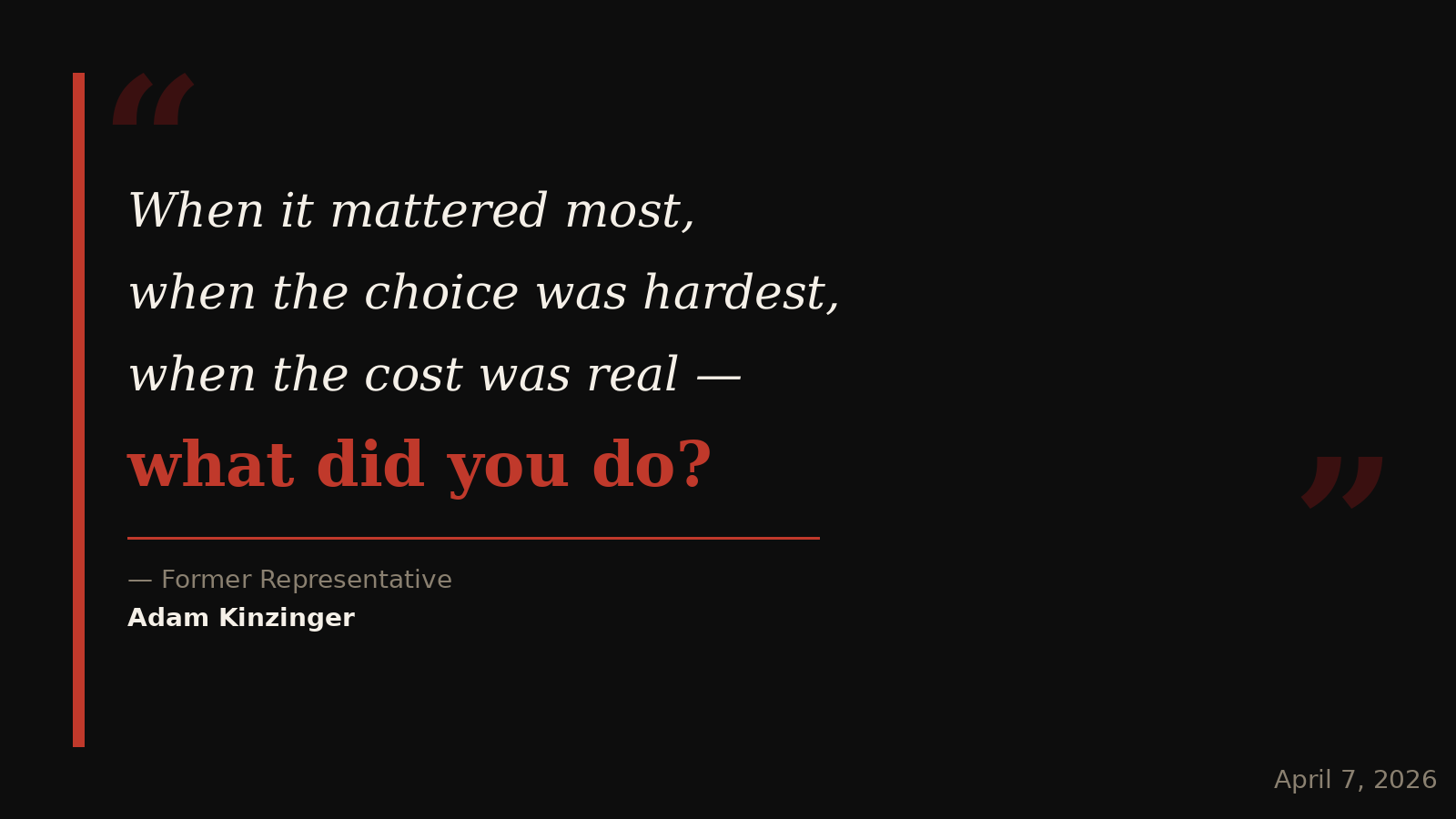
Not your political career. Your legacy. The thing your grandchildren will read about. The answer to the question every person in public life eventually has to answer: When it mattered most, when the choice was hardest, when the cost was real — what did you do?
I know what I did when it was my turn. I paid a price for it within my own party. I would do it again without hesitation, because there are things more important than party and more permanent than politics.
The history of this moment is being written right now, in real time, and your chapter is still blank.
You can still write it.
You have until tonight.
Choose.
Additional discussion video for paid members:
